Theme 01

Zero-shot intelligence for unseen distribution systems.

WattsMIND Grid Agent processes OpenDSS circuit files, learns the physical structure of SmartDSS-randomized distribution systems, and supports two core workflows: fast learned power-flow solves and agent control for cyber-attack mitigation, with 0 system-specific fine-tuning at test time.

0system-specific fine-tuning on held-out DSS systems

System and transfer setup

Random systems first. Held-out topology with 0 fine-tuning second.

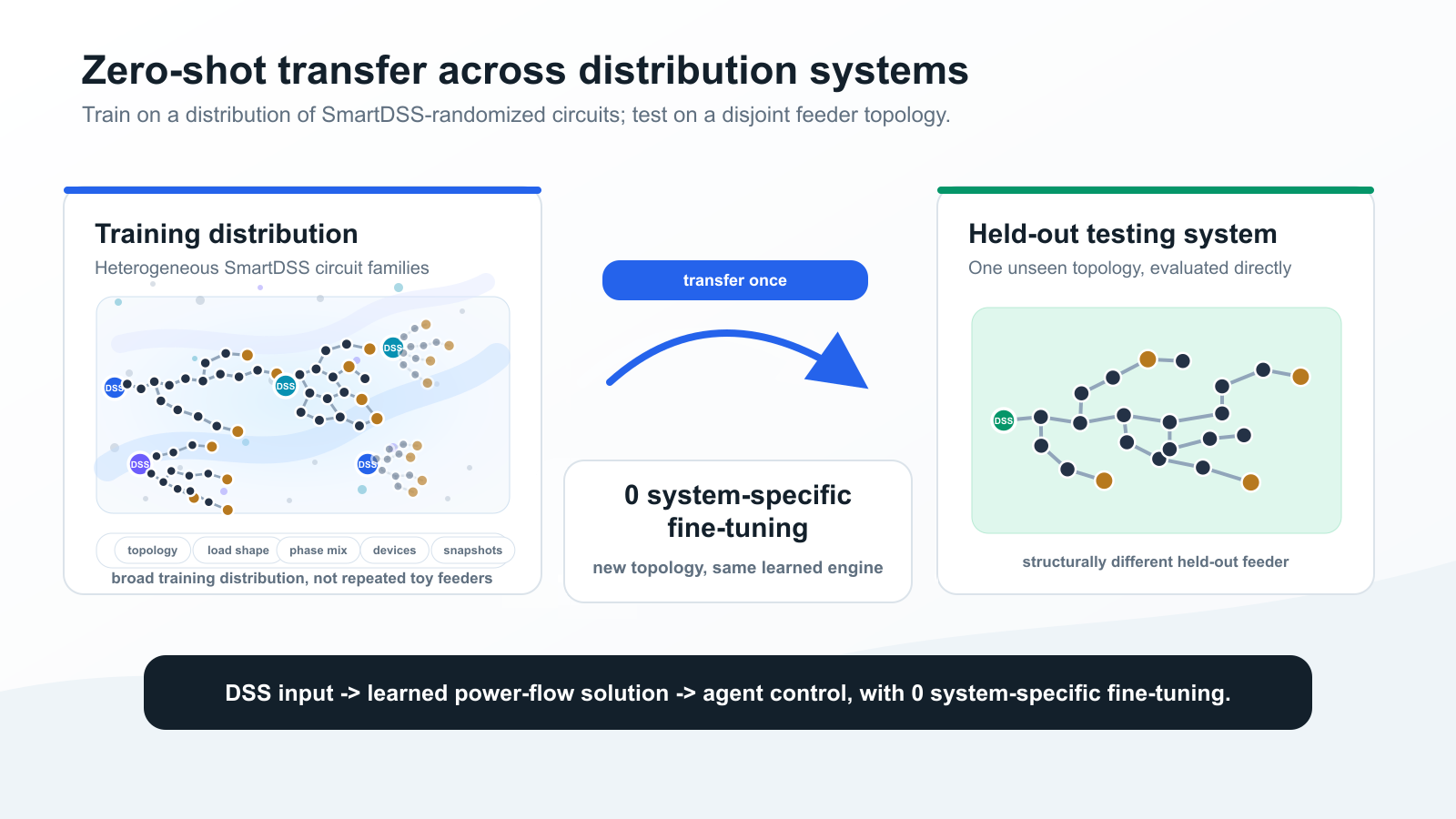
The experiments are built around SmartDSS-randomized distribution systems, not a single hand-tuned feeder. The held-out case is a disjoint OpenDSS topology used to test zero-shot solver and control behavior with 0 system-specific fine-tuning.
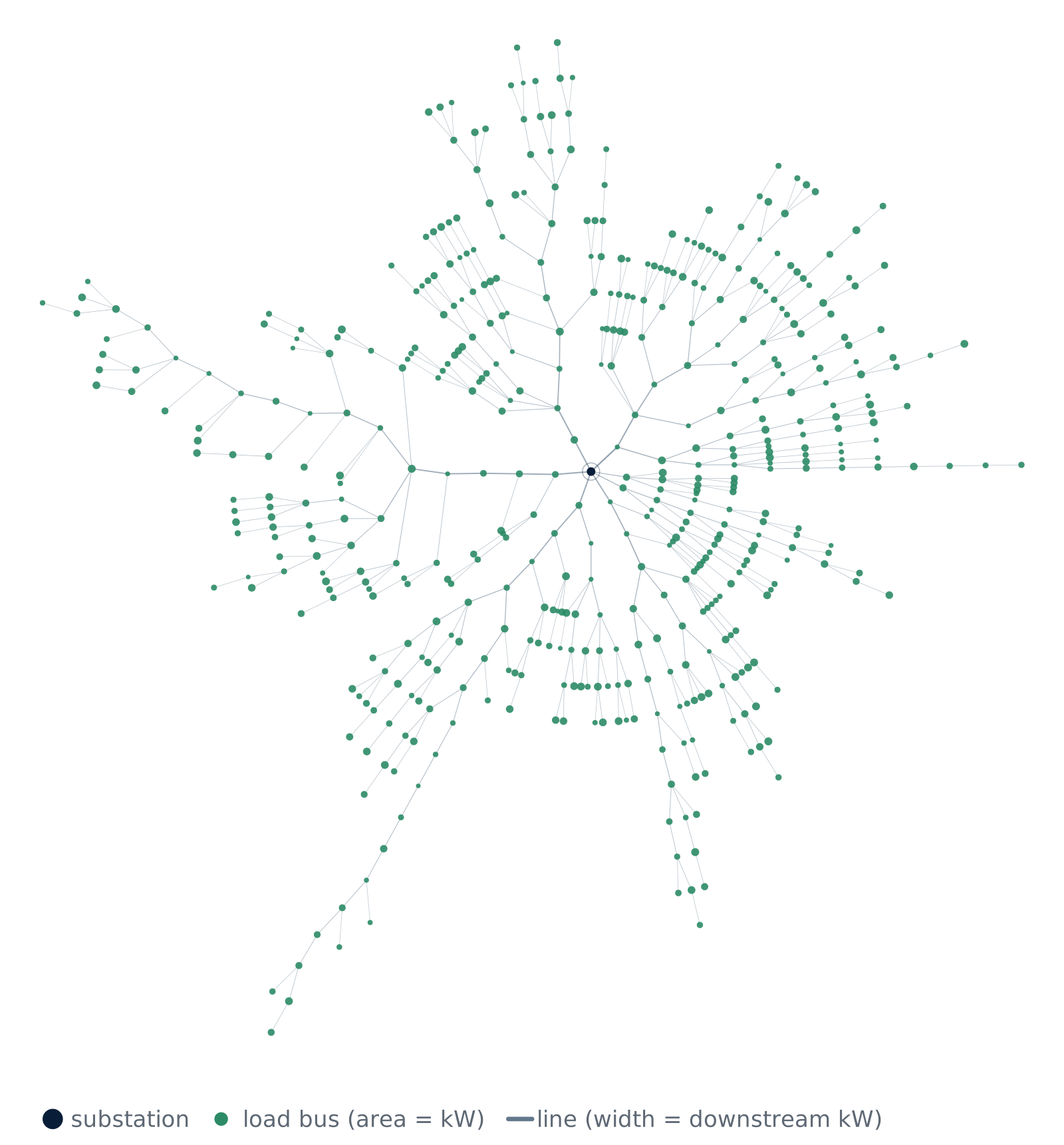
Radial distribution feeder topology: 500 buses branching from a single substation

Held-out system facts

271buses
270radial line segments
19384.2kW total load
11maximum tree depth
12.47 kVline-to-line base
3-phaseimbalanced feeder model

What the model receives

Raw DSS circuit files plus operating snapshots: topology, line parameters, phase loads, and device states. The learned solver must produce voltage phasors without retraining on this topology.
A SmartDSS/OpenDSS distribution system drawn from its exported graph. Rings are distance from the substation and line weight follows downstream load, so the feeder backbone reads as the backbone.
Zero-shot transfer illustration from SmartDSS training distribution to held-out testing distribution
Transfer setup: learn from a training distribution of SmartDSS-randomized systems, then evaluate solver and control behavior on a disjoint held-out testing distribution with 0 system-specific fine-tuning.

Application 01

A surrogate power-flow solve on a distribution system held out from training.

The model is not memorizing one circuit template. It is trained across SmartDSS-randomized distribution systems, then given a new DSS system description and asked to predict the three-phase voltage phasor solution produced by the power-flow solver.

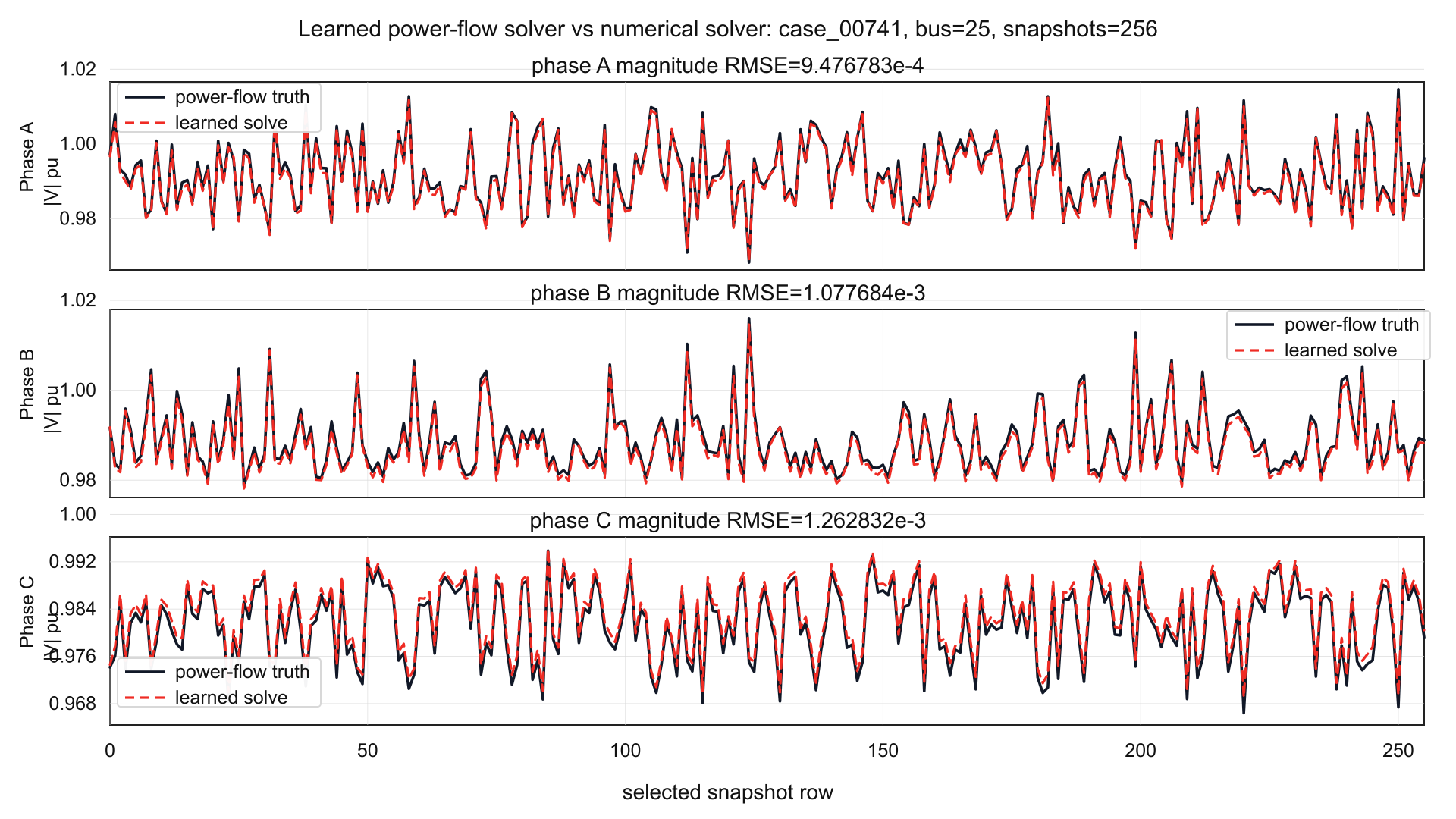
Experiment: SmartDSS randomly generates distribution systems; training and testing systems are disjoint. The test result is zero-shot power-flow solving on a completely unseen DSS topology with 0 system-specific fine-tuning.
0 system-specific fine-tuningSmartDSS-randomized distribution systemsDisjoint training and held-out testing distributions
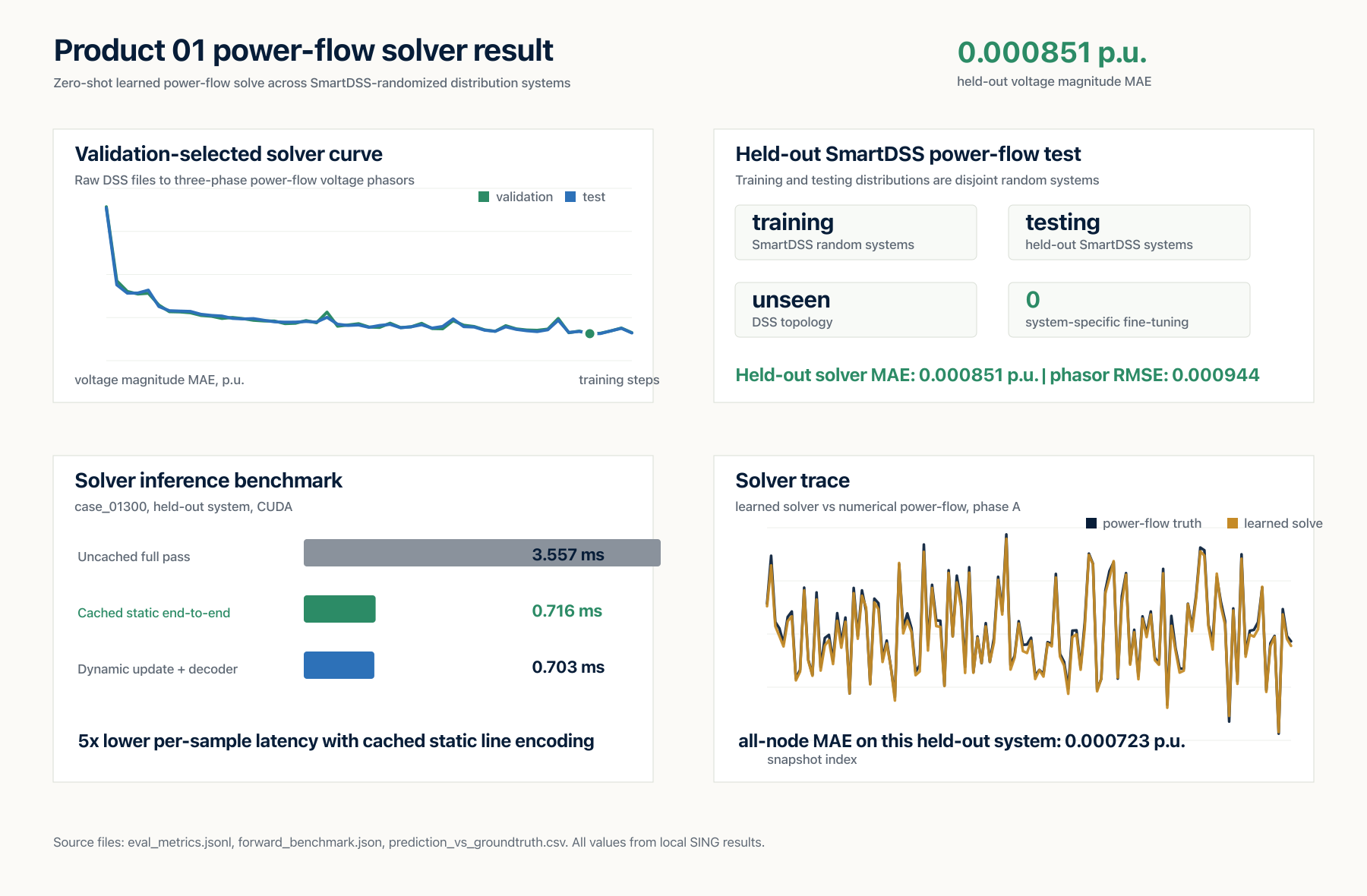
0.000851power-flow voltage magnitude MAE, p.u.
0.000944power-flow phasor RMSE
2.6%student loss relative to zero baseline
0.716 mscached end-to-end inference per sample
Three-phase voltage magnitude prediction versus ground truth on a held-out DSS feeder
Three-phase voltage magnitude from the learned solver versus numerical power-flow ground truth on a held-out SmartDSS-generated distribution system.
Theme 01 experimental result summary with training curve, model comparison, inference benchmark, and prediction trace
Validation-selected training curve, held-out SmartDSS random-system power-flow evaluation, cached inference benchmark, and prediction trace from the SING result set.

Application 02

Agent control for cyber-attack mitigation.

A cyber attack can push controllable devices in directions that amplify phase imbalance. WattsMIND Grid Agent observes the attacked operating trajectory and learns corrective control that suppresses imbalance close to the optimal controller.

Experiment: device-level 30% attack scenarios perturb phase behavior across SmartDSS random systems. The learned controller is compared against zero mitigation and an optimal control reference over the same attack rollout.
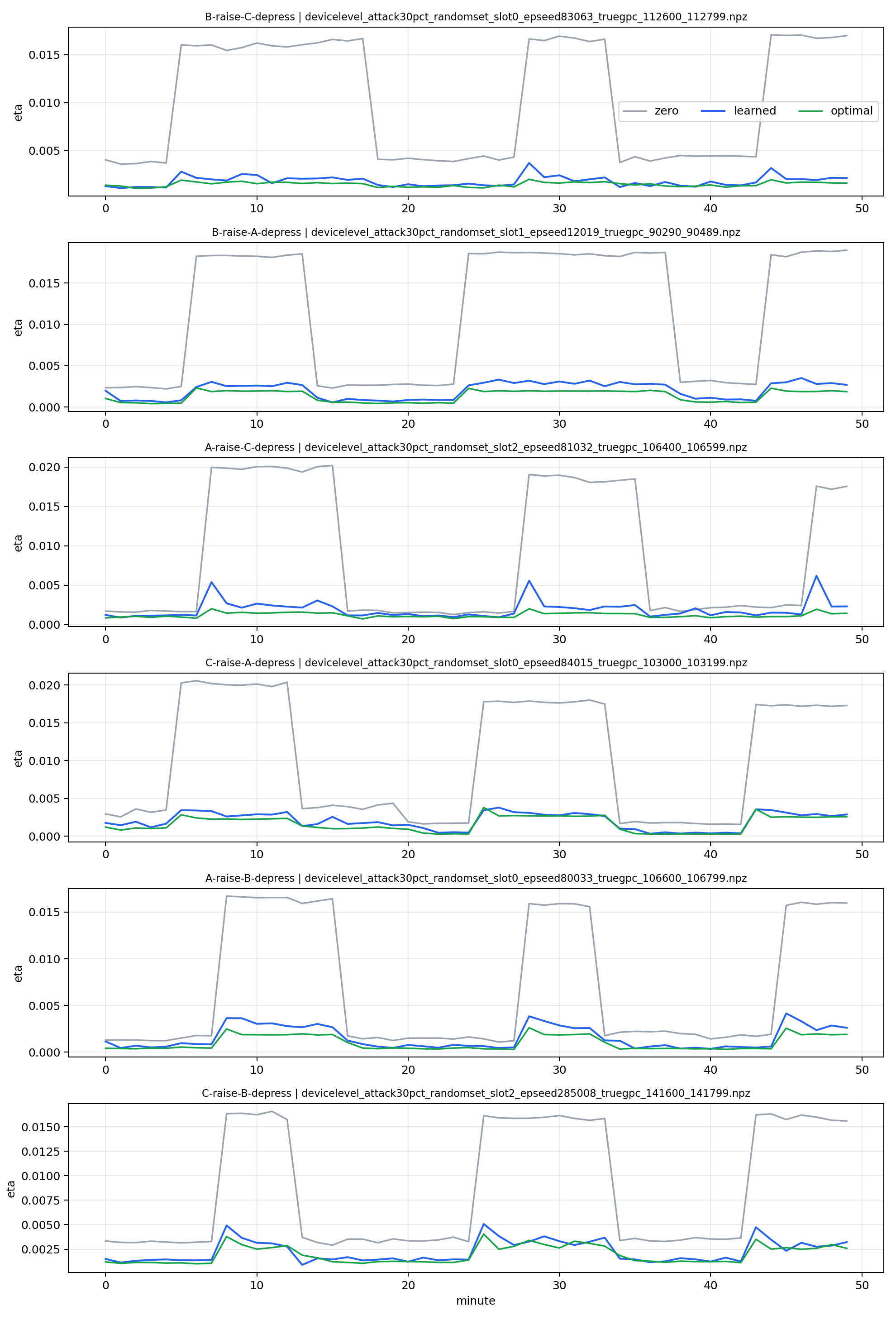
Cyber attack mitigation via agent controlZero mitigation vs learned control vs optimal referenceObjective: suppress phase-imbalance eta during attack windows
30%device-level attack scenario
6phase raise/depress attack cases shown
50 minmitigation rollout horizon
near-optimallearned control trajectory
Cyber attack mitigation curves comparing zero mitigation, learned control, and optimal control across phase imbalance scenarios
Phase-imbalance eta under device-level cyber attacks. Grey shows zero mitigation, blue shows learned agent control, and green shows the optimal controller.

Workflow

From DSS model to solver and control.

01

Read the DSS circuit

Start from a SmartDSS-generated OpenDSS system description: topology, phases, lines, loads, devices, and operating snapshots.

02

Solve the grid state

Predict the three-phase power-flow voltage solution on a different random system with 0 system-specific fine-tuning.

03

Observe attack impact

Track how device-level cyber attacks drive phase imbalance away from the nominal operating trajectory.

04

Apply agent mitigation

Select corrective controls that push the imbalance trajectory back toward the optimal controller reference.

Applications

  • Fast three-phase power-flow voltage solves
  • Zero-shot phasor solutions on unseen circuit topologies
  • Agent control for cyber-attack mitigation
  • Surrogate evaluation for distribution studies and operating scenarios

Why it matters

  • Turns raw circuit descriptions into voltage phasor solutions.
  • Controls phase imbalance under device-level attack scenarios.
  • Avoids fitting a separate model for every feeder topology or attack case.

Next step

Evaluate this research theme against a real grid workflow.

Discuss fit

Research themes